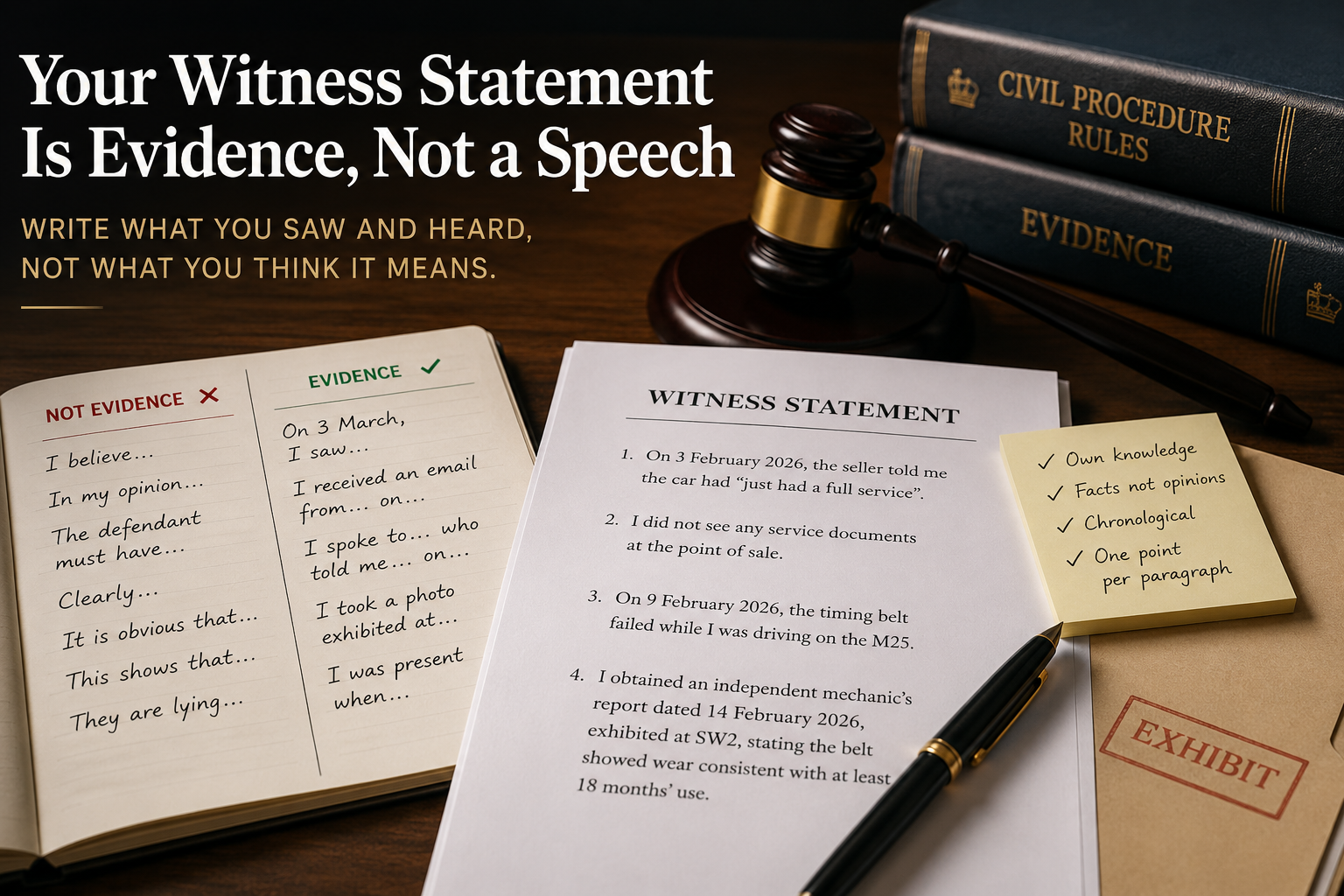

Most litigants in person make the same mistake with their witness statement: they treat it as their chance to argue the case. It isn’t. A witness statement is defined by CPR 32.4(2) as the evidence a person would be allowed to give if they stood up in court and spoke it aloud. If you wouldn’t be allowed to say it from the witness box, it doesn’t belong on the page — and judges are increasingly willing to strike statements down to size when that line is crossed.
Write what you saw and heard, not what you think it means. Keep that sentence in mind. Everything below is really just that idea applied to five different situations.
What actually counts as evidence
Evidence is something you personally observed, heard, said, or did. PD 32 paragraph 19.1 requires a statement to be written, as far as possible, in your own words, set out chronologically, with each paragraph confined to a single point and numbered.
Worked example — used car dispute
Weak: “The seller obviously knew the timing belt was about to fail and concealed this from me.”
Usable: “On 3 February the seller told me the car had ‘just had a full service.’ I did not see any service documents at the point of sale. On 9 February the timing belt failed while I was driving on the M25. I obtained an independent mechanic’s report dated 14 February, exhibited at SW2, stating the belt showed wear consistent with at least 18 months’ use.”
The first sentence is a guess about someone else’s state of mind, which you cannot give evidence of. The second is a sequence of things you experienced, backed by a document a judge can actually weigh.
The own-knowledge rule
PD 32 paragraph 18.2 requires you to make clear which parts of your statement are within your own direct knowledge and which are things you were told or believe. If you’re repeating something someone else told you, name them and say when.
Worked example — housing disrepair
Weak: “The landlord knew the roof had been leaking for months and ignored it.”
Usable: “On 14 March 2026 I noticed water dripping from the bathroom ceiling onto the landing carpet. I took photographs the same day, exhibited at SW1. I emailed the landlord, Mr Okafor, that evening describing the leak and attaching the photographs. I did not receive a reply for eleven days. My neighbour at number 12, Mr Patel, told me on 2 June that he had reported a similar leak the previous winter; I have no personal knowledge of that earlier report beyond what Mr Patel told me.”
Notice the last sentence: it doesn’t pretend Mr Patel’s account is your own observation, and it doesn’t hide that the knowledge is secondhand. That honesty is what PD 32 paragraph 18.2 actually asks for, and it’s also what stops the other side from successfully attacking the paragraph.
Argument and law don’t belong here either
In JD Wetherspoon plc v Harris [2013] EWHC 1088 (Ch); [2013] 1 WLR 3296, the court struck out the majority of a witness statement because it consisted of commentary on documents, argument, and submissions — the court called this “an abuse” of the witness statement’s purpose, since making arguments is the advocate’s job, not the witness’s. The same fate awaits a litigant in person’s statement that reads like a closing speech.
Worked example — workplace grievance
Weak: “My manager’s treatment of me clearly amounted to constructive dismissal and was a calculated attempt to force me out.”
Usable: “On 4 occasions between January and March 2026 my manager, Ms Kemal, removed work from my caseload without explanation. I raised this in a meeting on 19 March 2026; a note I made immediately afterwards is exhibited at SW3. On 2 April 2026 I submitted a written grievance, exhibited at SW4. I resigned on 30 April 2026. My letter of resignation is exhibited at SW5.”
Whether that sequence of events amounts to constructive dismissal is a legal question for your skeleton argument and for the tribunal to decide — not something to assert as fact in your own statement. State the events; let the document trail carry the weight.
Speculating about someone’s motive
This is the version of the same error that trips up neighbour disputes especially often, because motive feels like the whole point of the dispute.
Worked example — boundary dispute
Weak: “My neighbour built the fence two feet onto my land deliberately, to spite me after our argument about parking.”
Usable: “On 8 May 2026 I measured the new fence using a tape measure and found it was positioned approximately 0.6 metres inside the boundary line shown on the Land Registry title plan, exhibited at SW1. The fence was erected between 5 and 7 May 2026, while I was away; I did not see it being built. I have had no conversation with my neighbour about its position.”
You may strongly believe the fence was deliberate and spiteful. You have no way of giving direct evidence of what was in your neighbour’s head, so don’t try — give the measurements and the dates, and let the court draw its own inferences.
Recording impact without overreaching on intent
In harassment claims, litigants in person often combine two different things in one sentence: what happened, and what they believe the other person meant by it. Keep these separate.
Worked example — harassment claim
Weak: “He sent these messages to deliberately frighten and intimidate me, knowing exactly the effect they would have.”
Usable: “Between 1 and 15 June 2026 I received the seven text messages exhibited at SW6. After receiving the message on 9 June 2026, I did not sleep that night and contacted my GP the following morning; my GP’s note is exhibited at SW7. I have had no contact with the sender since 16 June 2026, when I changed my phone number.”
The effect on you is something you have direct knowledge of and can give evidence about. The sender’s intentions are not — that’s an inference for the court to draw from the pattern of conduct itself, supported by the Protection from Harassment Act 1997 framework your skeleton argument will set out separately.
Form: the part nobody reads until it costs them
PD 32 requires the statement to be headed with the case details, written in the first person, give your name, address or place of work, occupation, and your relationship to the case, and divided into numbered paragraphs, with each exhibit clearly labelled and referred to by that label in the text — commonly your initials plus a number, as in the examples above. PD 32 paragraph 25.1 gives the court power to refuse to admit a non-compliant statement, or to refuse the costs of preparing it. A judge won’t usually do that for a minor slip by a self-representing party, but a statement that ignores the structure entirely gives the other side something to attack before the substance is even considered.
The statement of truth is not a formality
Every witness statement must close with a statement of truth, in the exact wording set out at PD 22 paragraph 2.2: “I believe that the facts stated in this witness statement are true. I understand that proceedings for contempt of court may be brought against anyone who makes, or causes to be made, a false statement in a document verified by a statement of truth without an honest belief in its truth.” CPR 32.14 makes that consequence real: contempt proceedings can follow a false statement signed without honest belief in its truth. Don’t sign anything you’re not confident is accurate.
A complete worked example
Pulling the housing disrepair example into full form, here is what a compliant statement looks like end to end.
IN THE COUNTY COURT AT CHELMSFORD
Claim No: XX000000
BETWEEN:
SARAH WHITFIELD (Claimant)
—and—
OAK GROVE LETTINGS LTD (Defendant)WITNESS STATEMENT OF SARAH WHITFIELD
1. I am the Claimant in this case. I live at 14 Birch Court, Chelmsford, CM1 2AB, and am employed as a dental hygienist. The facts in this statement are within my own knowledge unless I state otherwise, and where they are not, I identify the source.
2. I have rented 14 Birch Court from the Defendant since 1 September 2024 under a written tenancy agreement, exhibited at SW1.
3. On 14 March 2026 I noticed water dripping from the bathroom ceiling onto the landing carpet. I took four photographs that day, exhibited at SW2.
4. On 14 March 2026 at 6.40pm I emailed the Defendant’s managing agent, Mr Okafor, describing the leak and attaching the photographs referred to above. A copy of that email is exhibited at SW3.
5. I did not receive any reply to that email for eleven days.
6. On 25 March 2026 Mr Okafor replied by email stating that a contractor would attend “within two weeks.” That email is exhibited at SW4.
7. No contractor attended within two weeks. A contractor attended on 22 April 2026, twenty-eight days after Mr Okafor’s email.
8. Between 14 March 2026 and 22 April 2026 I placed a bucket beneath the leak each evening before going to bed and emptied it each morning. I estimate I did this on approximately 35 occasions.
9. My neighbour at 12 Birch Court, Mr Patel, told me on 2 June 2026 that he had reported a similar leak from the same roof area the previous winter. I have no personal knowledge of that earlier report beyond what Mr Patel told me.
10. I believe the matters set out above are within my own knowledge and are true, save where I have indicated otherwise.
Statement of Truth
I believe that the facts stated in this witness statement are true. I understand that proceedings for contempt of court may be brought against anyone who makes, or causes to be made, a false statement in a document verified by a statement of truth without an honest belief in its truth.Signed: ______________________
Sarah Whitfield
Dated: [date]
Notice what isn’t there: no reference to the Landlord and Tenant Act, no assertion that the delay was “unreasonable” or “in breach,” no claim about what Mr Okafor was thinking. Every paragraph is a fact, a date, or an honestly labelled secondhand account, each backed by an exhibit where one exists. That is what makes it usable evidence rather than an extended complaint with a signature on the bottom.
Write what you saw and heard, not what you think it means. Build your own statement the same way: chronological, numbered, sourced, and quietly empty of argument — then let your exhibits and your skeleton do the persuading.