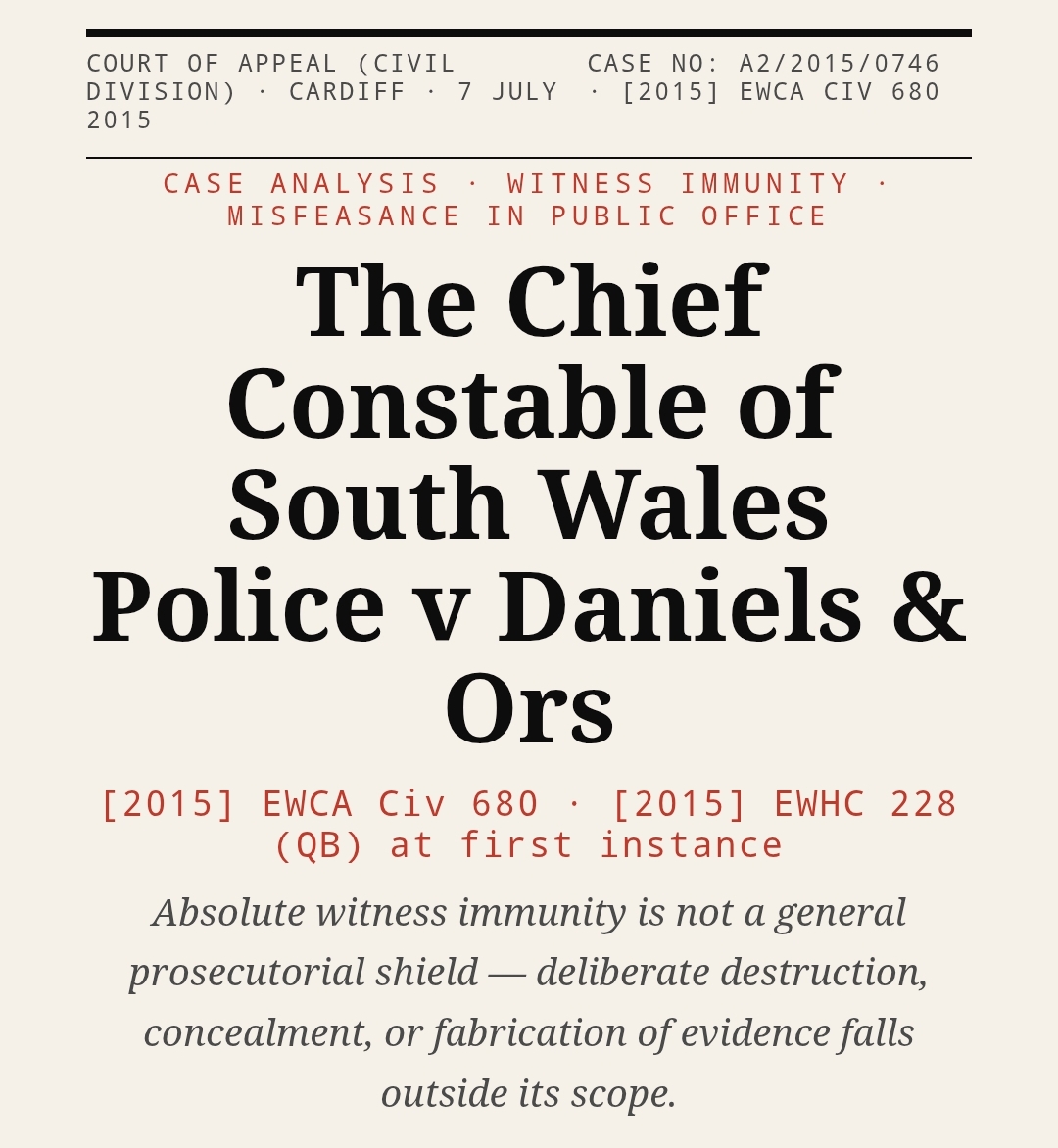

The Chief Constable of South Wales Police v Daniels & Ors [2015] EWCA Civ 680 — Case Review
Court of Appeal (Civil Division) | McFarlane, Davis & Lloyd Jones LJJ | 7 July 2015
Background
This appeal arose from one of the most protracted and legally complex civil actions in recent Welsh legal history — itself a downstream consequence of the wrongful conviction of the Cardiff Three for the 1988 murder of Lynette White. Three former South Wales Police officers (Daniels, Gillard, and Murray) brought civil claims against the Chief Constable for malicious prosecution, unlawful detention, and misfeasance in public office. The immediate question before the Court of Appeal was narrower: whether the respondent officers should be permitted to amend their pleadings to advance misfeasance allegations, and whether those allegations were barred by the absolute immunity that attaches to participants in the judicial process.
The appeal followed a two-stage procedural history. At first instance, HHJ Seys Llewellyn QC had refused most of the proposed amendments on the basis that they fell within a broad prosecutorial immunity. On appeal to the High Court, Gilbart J allowed the amendments in full, concluding that it was not always possible to draw a clear bright line between the investigatory and judicial phases of a prosecution. The Chief Constable then appealed to the Court of Appeal on three grounds: that Gilbart J had erred on immunity (Ground 2), that the respondents’ successive applications were an abuse of process (Ground 1), and that Gilbart J had wrongly permitted a specific “apology pleading” (Ground 3).
The Immunity Question — Ground 2
The central legal question, and the most significant contribution of this case, concerns the scope of the absolute witness immunity. The Court of Appeal, in a judgment delivered by Lloyd Jones LJ (with Davis and McFarlane LJJ agreeing), undertook a careful and authoritative re-examination of the doctrine, culminating in a clear rejection of the broad prosecutorial immunity that Judge Seys Llewellyn had applied below.
The starting point was Darker v Chief Constable of the West Midlands Police [2001] 1 AC 435, the leading House of Lords authority. In Darker, the Lords unanimously held that absolute immunity did not extend to the fabrication of evidence by police officers, though their Lordships reached that conclusion through differing routes, producing some interpretive uncertainty. That uncertainty was precisely what the present appeal required the Court of Appeal to resolve.
Lloyd Jones LJ identified two competing readings of Darker. The broader reading, favoured by the Chief Constable, drew on passages from Lords Cooke and Clyde which invoked the American “functional” test from Imbler v Pachtman — that activities “intimately associated with the judicial phase of the criminal process” attract immunity regardless of whether they involve the giving of evidence. Judge Seys Llewellyn had adopted this reading, articulating a general prosecutorial immunity that extended to the initiation, continuation, and conduct of criminal proceedings, not limited to the witness box.
Lloyd Jones LJ firmly rejected this interpretation. The ratio of Darker, he held, is to be found in the reasoning of Lords Hope, Mackay, and Hutton, all of whom emphasised that the immunity is essentially a witness immunity — protecting statements made in the course of giving evidence, and necessarily extended to certain preparatory activities, but not stretching to the prosecutorial function at large. The critical passage from Lord Hope — that the immunity “is not to be used to shield the police from action for things done while they are acting as law enforcers or investigators” — was treated as definitive. The mere fact that an activity is intimately associated with the judicial phase does not, of itself, confer immunity. That is a factor, not a conclusion.
This reading brings welcome analytical clarity to a doctrine that had been accumulating doctrinal clutter since Taylor v Director of the Serious Fraud Office [1999] 2 AC 177, in which the Lords had extended the immunity to out-of-court statements made in the course of investigating crime with a view to prosecution. Lloyd Jones LJ accepted Taylor as correctly decided but declined to read it as authority for a general prosecutorial immunity. The extension is functional and purposive: it exists to enable witnesses to speak freely and to permit investigators to exchange information without fear of suit, not to immunise deliberate misconduct from civil accountability.
Two propositions of practical importance emerge from this analysis. First, for the immunity to apply, the cause of action itself must be founded on the content of a statement made in or preparatory to judicial proceedings — citing Lord Hoffmann in Taylor and Lord Hope in Darker to the effect that the immunity “is limited to actions in which the alleged statement constitutes the cause of action.” This is a causation test, not merely a proximity test. A claim that the police deliberately withheld or destroyed documents is not a claim founded on any statement; it is a claim founded on conduct, and conduct of a type that cannot shelter behind witness immunity.
Second, the Court confirmed the lower court’s unchallenged ruling — and then extended its logic — that just as the fabrication of evidence does not attract immunity (Darker), neither does the deliberate destruction or concealment of documents material to the defence. The symmetry is compelling: it would be absurd to deny immunity to a police officer who creates false evidence while granting it to one who suppresses true evidence. Both involve the same fundamental abuse of the judicial process; both defeat the purpose the immunity was designed to serve.
The Court also drew support from Smart v Forensic Science Service Limited [2013] EWCA Civ 783, where the Court of Appeal had declined to strike out claims in negligence and deceit against a forensic scientist who had altered a draft report. The principle emerging from Smart — that witness immunity covers giving evidence and preparing to give it, but not the fabrication or manipulation of evidence never intended to appear in any statement — reinforces the line the Court draws in Daniels.
The practical consequence was that the bulk of the proposed misfeasance amendments survived. Claims relating to the deliberate concealment, withholding, and destruction of disclosure documents; to systematic failures in the disclosure process; and to improper contact with the original defendants and the Cardiff Three campaign were all held to fall outside the scope of the absolute immunity, at least arguably. The Court agreed with Gilbart J that the trial judge should rule on immunity on the basis of findings of fact. The only aspect of Ground 2 on which the Chief Constable succeeded was the disallowance of a catch-all cross-reference in the Daniels and Gillard pleadings, which had attempted to import malicious prosecution particulars wholesale into the misfeasance claim — a pleading technique that the Court rightly rejected as insufficiently particularised and potentially requiring the defendant to identify for himself what conduct might engage an exception to immunity.
Abuse of Process — Ground 1
Ground 1 was disposed of quickly and correctly. The argument — that the respondents’ failure to appeal Judge Seys Llewellyn’s June 2013 ruling barred any later challenge to the same immunity analysis — was rejected on three grounds. First, the November 2014 judgment concerned different, more extensive amendments; a failure to appeal an earlier refusal does not preclude challenging a later refusal in different terms. Second, only Daniels had been party to the June 2013 application; Gillard and Murray could not logically be bound by a judgment in proceedings to which they were not party. Third, and most fundamentally, the lower court had applied an erroneous legal principle in 2013, and neither an appellate court nor a party should be locked into perpetuating an error simply because it was not challenged at the earliest opportunity.
The Apology Pleading — Ground 3
Ground 3 produced the sharpest divergence between the courts below. Daniels and Gillard sought to introduce particulars alleging that the decision to prosecute the respondent officers in 2009 was motivated, at least in part, by the Chief Constable’s desire to assist his negotiating position in the civil claims brought by the Cardiff Three — claims that had been settled with substantial apologies issued in coincident timing with the decision to prosecute.
Judge Seys Llewellyn refused this amendment on the combined weight of several factors: the inference sought to be drawn was inherently fragile given the public apology issued as early as 2003; the amendments were brought very late; they directly contradicted a court order of December 2013 requiring particulars of the same matter which had never been complied with; they raised confidentiality issues attaching to mediation settlement terms; and they would generate significant additional costs and duplication.
Gilbart J had reversed this on appeal, substituting his own assessment of the relevance of the apology. The Court of Appeal restored the first instance order, applying orthodox appellate restraint in case management matters: a first instance judge’s discretion on such questions should only be disturbed if he applied the wrong principles or reached a conclusion outside the ambit of reasonable decisions available to him. Gilbart J had failed to grapple with the carefully balanced reasoning of Judge Seys Llewellyn and had simply preferred a different view, which is not a permissible basis for appellate intervention in case management.
Significance
Daniels matters beyond its facts for three reasons. First, it settles — as authoritatively as a Court of Appeal decision can — that absolute witness immunity in England and Wales is not a general prosecutorial immunity. Police officers who fabricate, destroy, conceal, or deliberately withhold evidence cannot invoke the doctrine. The immunity is precisely calibrated to the purpose it serves: protecting the freedom and integrity of witnesses, not shielding systemic misconduct in the investigation and preparation of criminal cases.
Second, it clarifies the causation requirement articulated in Taylor and Darker: the cause of action itself must be grounded in the content of the statement. Claims founded on conduct — on what was done to documents, to witnesses, or to the integrity of the process — are not claims founded on statements, and the immunity simply has no purchase on them.
Third, its procedural lesson is enduring: case management decisions deserve genuine appellate deference, and a judge who re-exercises a discretion without confronting the reasoning of the judge below has not conducted an appeal — he has conducted a re-hearing, which is an error of principle.